FROM BEHIND THE SCENES
ENTTEC’s Role in Bringing Watercolors to Life at MSY Airport

Airports are not usually places where people stop and take in a moment, but at Louis Armstrong New Orleans International Airport something unexpected happens. Travelers heading to their gates begin to slow down. A pair of quiet, grayscale portraits starts to glow. Then, slowly, color spreads across the images. Details sharpen. Movement appears. The past steps into the present right there in the terminal.
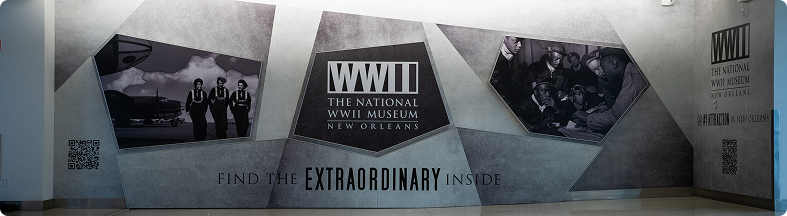
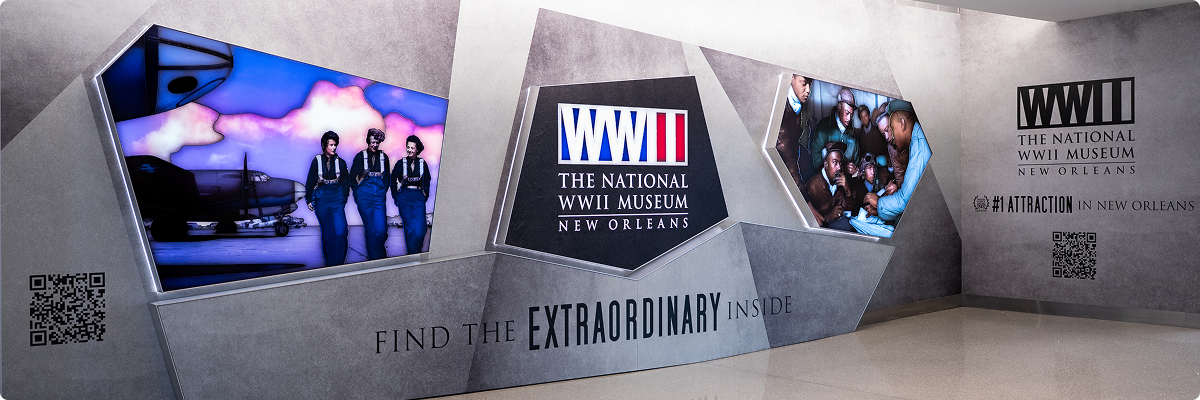
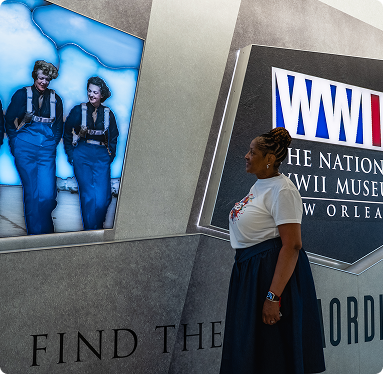
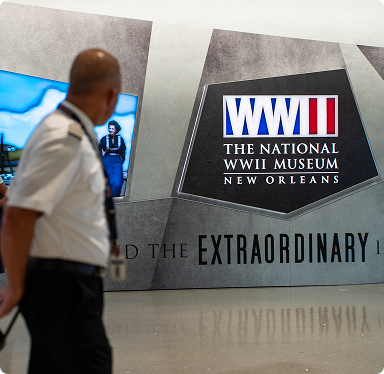
This is Watercolors, an installation created by Luminary Design and inspired by The National WWII Museum’s “Find the Extraordinary Inside” campaign. Images of WWII aviators, originally captured only in black and white, are brought into full color and motion through a display medium Luminary developed called Magic Portraits.
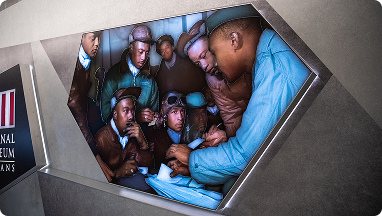
Tuskegee Airmen Magic Portrait
ENTTEC’s control ecosystem powers the transformation happening beneath the surface, but the stories unfolding on the surface belong entirely to the veterans whose courage defined a generation.
Magic Portraits: Where Light, Print, and Storytelling Meet
To understand Watercolors, it helps to understand what makes Magic Portraits so distinctive. They are not digital screens. They are hand-built hybrids composed of printed artwork, precision-cut acrylic diffusers, and thousands of addressable LEDs arranged around the geometry of each photograph.
After reviewing numerous historical images, Luminary selected two portraits that honor trailblazing aviation units whose stories reflect both courage and quiet defiance.
The first features the Tuskegee Airmen, the first African American military pilots to fly for the United States and see combat overseas.
The second highlights the Women Airforce Service Pilots (WASP), pioneers whose contributions shaped military aviation while receiving little recognition for decades.
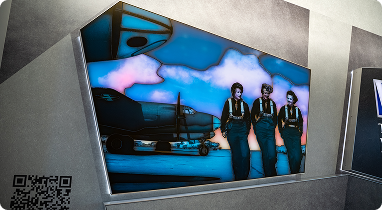
Women Airforce Service Pilots (WASP) Magic Portrait
The Luminary team spent years refining the Magic Portraits medium. In grayscale, each portrait functions as a clear and well-defined image. Luminary explained this stage:
“In its passive state, in just black and white print, it looked beautiful, like a printed image. And in its active state, the color was rich and the brightness was exactly what we were looking for.”
When illuminated, controlled color and motion reveal details not visible in the original photographs. The transformation is subtle but effective, giving travelers a more immediate sense of the aviators represented. As the team put it,
“If the average viewer is walking past, they’ll see these amazing historical photos, but if they stick around for a little longer… they could see a beautiful animation that really brings the pictures and the story to life.”
Achieving this required a technical foundation capable of precise timing, color control, and pixel accuracy.
The Engineering That Made It Possible
Magic Portraits rely on a complex lighting architecture that extends far beyond the structure of traditional displays. Each portrait is built on irregular geometry, with LED strips placed to follow the contours, shadows, and structural features of the original photographs.
Every LED diode is individually mapped and addressed, allowing light to move with precision across the artwork.
This meticulous construction also made possible one of the installation’s most innovative elements, the Live Sky. In the Daughters to Defenders portrait, a broad stretch of printed sky became an opportunity for environmental storytelling. Rather than leaving it static, Luminary created a dynamic sky that shifts with the actual time of day inside the airport terminal.
Four sky states were created:
• Dawn
• Day
• Dusk
• Twilight
Using ENTTEC LED Mapper, the system transitions between these looks smoothly, allowing the portrait to echo the natural rhythm of the terminal. Luminary shared,
“Depending on the actual time of day in the terminal, you will see the sky that reflects that in real time. And after much testing, we landed on a result we were all happy with.”
Delivering this experience required pixel-level precision and a control system capable of driving more than thirty thousand LEDs at sixty frames per second. ENTTEC’s hardware and software enabled Luminary to map complex geometry, layer controlled animation, and maintain transitions that feel natural rather than digital.
As the team reflected on the process,
“Nearly two years of development, testing, and engineering went into refining this technology, and the Luminary team is so excited to finally be sharing Watercolors with the world.”
This integration of engineering and artistic intent transforms Watercolors from a lighting installation into a complex storytelling medium.
How ENTTEC Helped Build the Canvas
Behind the scenes, Watercolors is powered by a complete ENTTEC ecosystem designed for complex, non-standard installations.
ENTTEC Technology at Work
192 DMX universes
More than 30,000 individually addressable LEDs
ENTTEC LED Mapper (ELM) driving multilayer animations
During development, ELM became central to the creative and technical refinement process. It allowed the team to map LEDs across custom geometry with pixel-level accuracy, layer animation, and fine-tune transitions until they matched both visual and emotional intent.
A Display That Feels Effortless Because It Is Not
To travelers, Watercolors appears calm and weightless. Behind the printed artwork is a precisely coordinated system operating at significant scale. Nearly two years of development, engineering, testing, and iteration led to the installation seen today.
The result is a piece that invites reflection in a place designed for movement. It expands what is possible when creative teams have the right tools to support unconventional ideas, custom geometry, and extremely high pixel densities.
Honoring History Through Technology
ENTTEC provides the control technology that lifts the portraits into motion, but the heart of Watercolors lies in the individuals it honors. Each Magic Portrait restores visibility, emotion, and humanity to aviators whose contributions shaped history.
The piece invites travelers to pause, connect, and reflect. This is storytelling through engineering, not for spectacle but for remembrance.